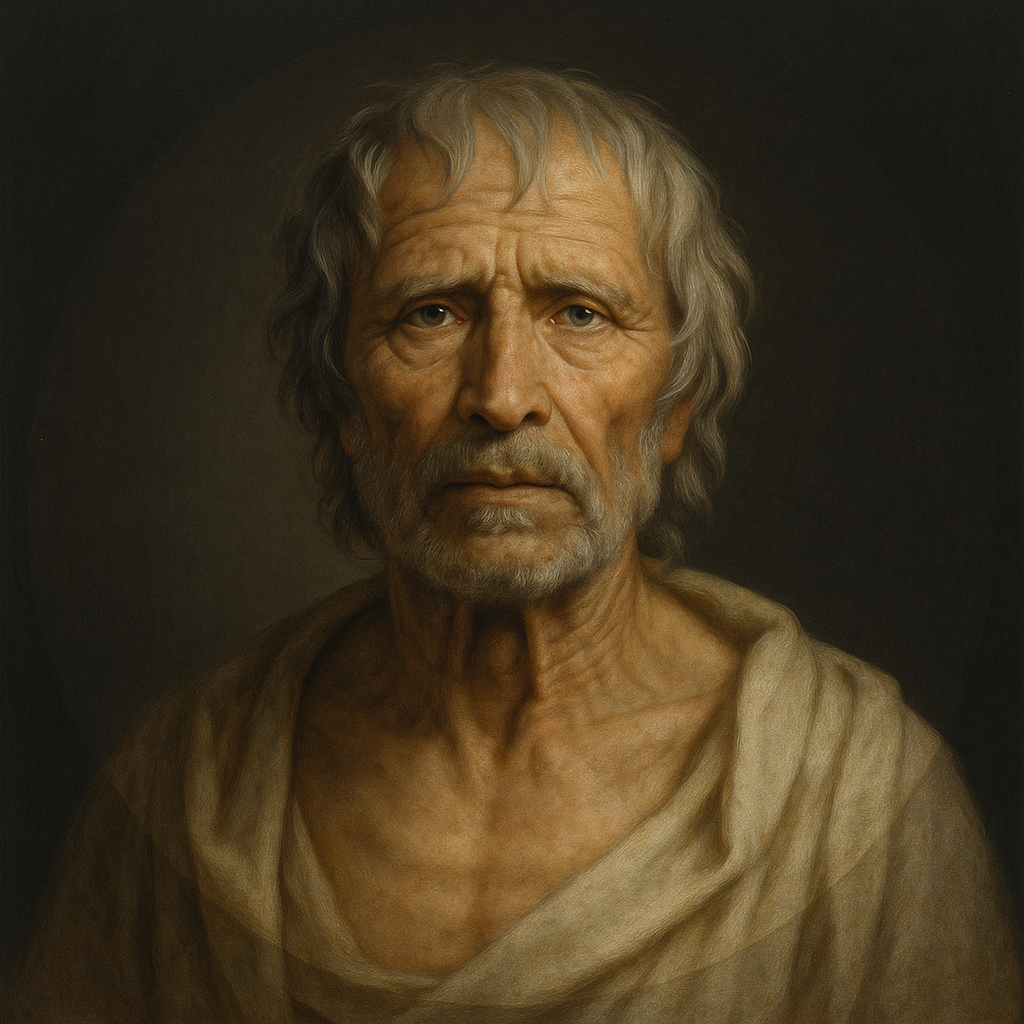
At a glance
- From
- Stagira, Chalcidice, Ancient Greece
- Lives in
- Athens
Biography
The line most often lifted from his work is the claim that happiness is not a mood but an activity — the soul acting in accordance with virtue, held up by community and law. That idea comes from the Nicomachean Ethics, where virtue is treated as a habit you cultivate rather than a trait you either have or lack, aimed at a mean between extremes and directed towards human flourishing. He wrote about friendship, the formation of character, and practical wisdom, and he was careful not to reduce any of it to a formula.
Born in Stagira in Chalcidice, he studied at Plato's Academy before setting up his own school, the Lyceum. Teaching there took place while walking with students, in what became known as the peripatetic tradition — an image of philosophy done on the move that has outlasted most of his conclusions. He drilled students in argument, definition, and the noticing of distinctions. His prose was built for clarity, not decoration.
The range of the work is unusual. His logical treatises, later gathered as the Organon, set out syllogistic inference and shaped scholarly method for two thousand years. He compiled biological observations, classified animals, and explained organs and functions in terms of their purposes. His metaphysics dealt systematically with being, causation, form and substance; he also wrote on rhetoric and poetics, on persuasion, tragedy and catharsis. In politics he compared constitutions, asking how communities might cultivate civic virtue. He tutored Alexander the Great, an experience that put him near live arguments about education and rule, though his own political commitments were not straightforward.
Plenty of his specific claims were later corrected, and scientific revolutions overturned his physics — while often keeping his vocabulary of causes and explanation. His texts passed through antiquity into medieval Islamic and Christian scholarship, where they were translated, expanded and argued over; scholastic thinkers bent his logic and metaphysics towards theology and law, and Renaissance humanists rejected some doctrines while keeping his analytical tools. Contemporary philosophers still return to him on teleology, virtue and practical reason.
Born in Stagira in Chalcidice, he studied at Plato's Academy before setting up his own school, the Lyceum. Teaching there took place while walking with students, in what became known as the peripatetic tradition — an image of philosophy done on the move that has outlasted most of his conclusions. He drilled students in argument, definition, and the noticing of distinctions. His prose was built for clarity, not decoration.
The range of the work is unusual. His logical treatises, later gathered as the Organon, set out syllogistic inference and shaped scholarly method for two thousand years. He compiled biological observations, classified animals, and explained organs and functions in terms of their purposes. His metaphysics dealt systematically with being, causation, form and substance; he also wrote on rhetoric and poetics, on persuasion, tragedy and catharsis. In politics he compared constitutions, asking how communities might cultivate civic virtue. He tutored Alexander the Great, an experience that put him near live arguments about education and rule, though his own political commitments were not straightforward.
Plenty of his specific claims were later corrected, and scientific revolutions overturned his physics — while often keeping his vocabulary of causes and explanation. His texts passed through antiquity into medieval Islamic and Christian scholarship, where they were translated, expanded and argued over; scholastic thinkers bent his logic and metaphysics towards theology and law, and Renaissance humanists rejected some doctrines while keeping his analytical tools. Contemporary philosophers still return to him on teleology, virtue and practical reason.
Known For
Foundational works in logic, ethics, politics, biology, and metaphysics; founder of the Lyceum.
Quotes 10
“Whosoever is delighted in solitude is either a wild beast or a god.”
“Well begun is half done.”
“Hope is a waking dream.”
“Pleasure in the job puts perfection in the work.”
“He who has overcome his fears will truly be free.”
“Patience is bitter, but its fruit is sweet.”
“The roots of education are bitter, but the fruit is sweet.”
“Knowing yourself is the beginning of all wisdom.”
“It is during our darkest moments that we must focus to see the light.”
“It is the mark of an educated mind to be able to entertain a thought without accepting it.”