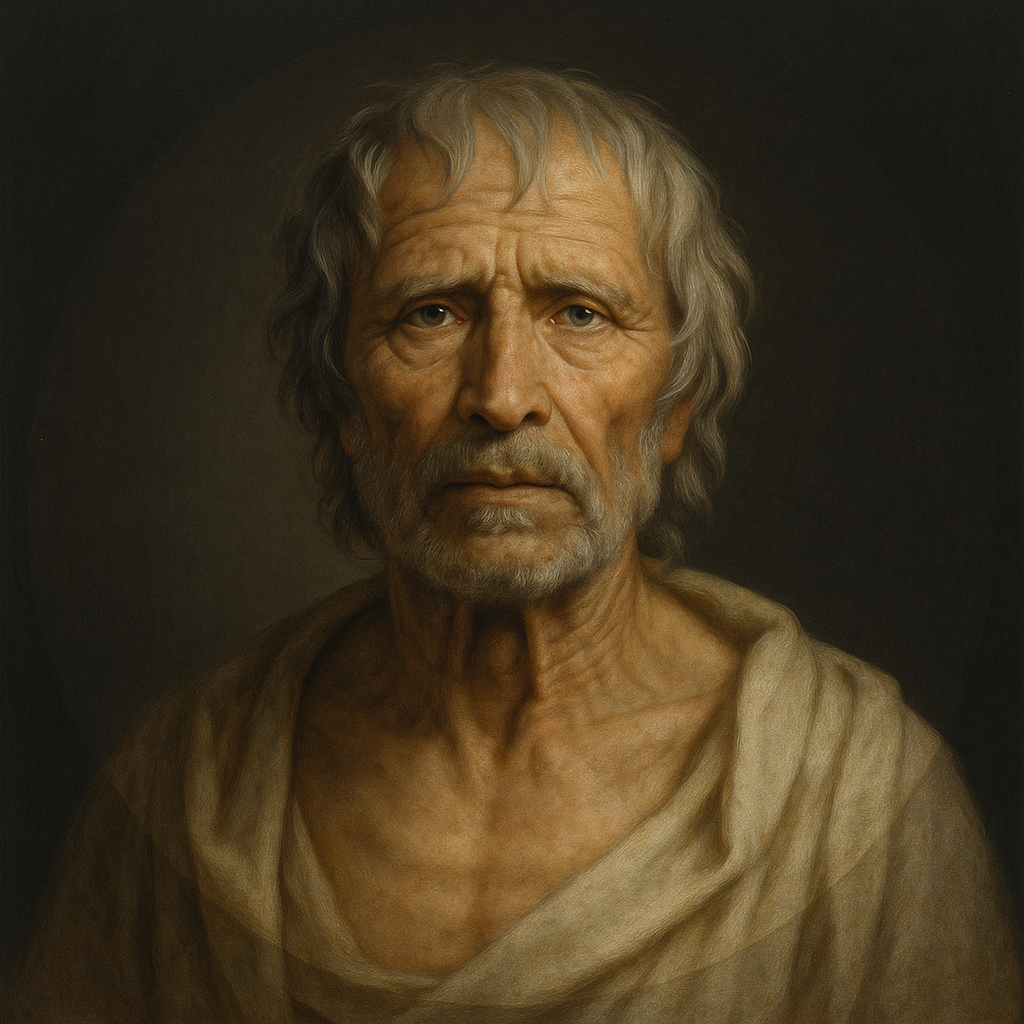
At a glance
- From
- Qufu, State of Lu (China)
- Nationality
- Lu
Biography
The lines people quote about self-cultivation, about the ruler who governs by virtue instead of fear, about courtesy as the thing that holds public life together — most of them come from the Analects, a collection his students assembled from his sayings and the example he set. It reads as a mosaic rather than a treatise: instruction, exchange, correction. The teacher in it is patient but not soft. He asks a lot.
His core claim was that moral work begins with the individual and spreads outward, from the person to the family, then to the community and the state. Rites and manners were not decoration in this scheme but training — habits that turn respect into something practised rather than merely felt, exercises in attention. Study, honest self-examination and friendship were the tools of growth. He put weight on sincerity and on speaking in a way that fitted the moment. Education, in his account, was a duty rather than a privilege, and the aim of the gentleman was steadiness, not display.
He lived through political fragmentation and spoke to it directly, advising rulers on governing in an orderly way rooted in benevolence and righteousness, and telling officials to serve with both loyalty and candour. Moral authority, he argued, was what gave law its legitimacy. He read the classics as a way of bringing older wisdom to bear on current problems. He moved between courts looking for appointment and often ended up teaching from outside power instead. He refused cynicism, holding that small acts of courtesy keep trust alive.
What followed was centuries of commentary and competing schools arguing over text, ritual and metaphysics, and examination systems that made his emphasis on learning an institution. Reformers and revolutionaries have argued with that inheritance, attacking its hierarchies while keeping its insistence on responsibility. Readers still go to the Analects for guidance on civic, educational and family life, and the tradition remains a case for treating ethics as a craft to be worked at rather than a rule handed down.
His core claim was that moral work begins with the individual and spreads outward, from the person to the family, then to the community and the state. Rites and manners were not decoration in this scheme but training — habits that turn respect into something practised rather than merely felt, exercises in attention. Study, honest self-examination and friendship were the tools of growth. He put weight on sincerity and on speaking in a way that fitted the moment. Education, in his account, was a duty rather than a privilege, and the aim of the gentleman was steadiness, not display.
He lived through political fragmentation and spoke to it directly, advising rulers on governing in an orderly way rooted in benevolence and righteousness, and telling officials to serve with both loyalty and candour. Moral authority, he argued, was what gave law its legitimacy. He read the classics as a way of bringing older wisdom to bear on current problems. He moved between courts looking for appointment and often ended up teaching from outside power instead. He refused cynicism, holding that small acts of courtesy keep trust alive.
What followed was centuries of commentary and competing schools arguing over text, ritual and metaphysics, and examination systems that made his emphasis on learning an institution. Reformers and revolutionaries have argued with that inheritance, attacking its hierarchies while keeping its insistence on responsibility. Readers still go to the Analects for guidance on civic, educational and family life, and the tradition remains a case for treating ethics as a craft to be worked at rather than a rule handed down.
Known For
The Analects; ethics of ritual, benevolence, and righteous rule.
Quotes 6
“The superior man is modest in his speech, but exceeds in his actions.”
“He who learns but does not think is lost. He who thinks but does not learn is in great danger.”
“When anger rises, think of the consequences.”
“Our greatest glory is not in never falling, but in rising every time we fall.”
“The man who moves a mountain begins by carrying away small stones.”
“It does not matter how slowly you go as long as you do not stop.”