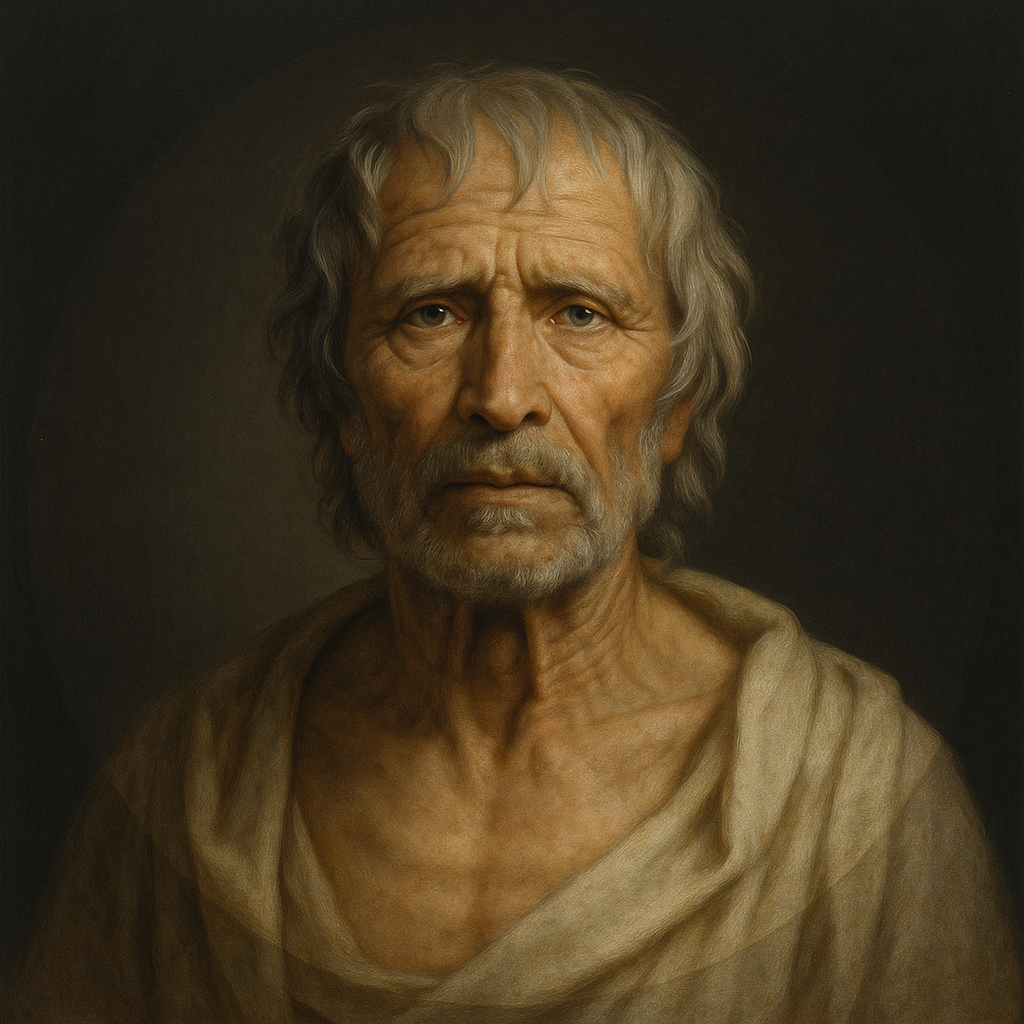
At a glance
- Age
- 65
- Born
- May 7, 1711
- From
- Edinburgh, Scotland
- Nationality
- Kingdom of Great Britain
Biography
If you have heard the line that we never actually observe one thing causing another — only one thing following another — you have met the argument David Hume is best known for. He questioned whether the connections we take for granted between events are found in the world or supplied by the habits of our own minds. Alongside that scepticism ran a second, more constructive ambition: to build a science of human nature, treating thought, feeling and judgement as subjects that could be studied with the same care given to anything else.
He was born in Edinburgh in 1711 and worked as a philosopher, historian and economist in what was then the Kingdom of Great Britain. His training combined close attention to method with a willingness to synthesise across fields, and his early writing set a pattern he kept: taking inherited assumptions apart, then restating the problem in a sharper and more workable form. Reading, travel and correspondence widened the range of material he could draw on. What stood out in the first results was less the novelty of the claims than the clarity with which they were put — and clarity became something close to a working principle for him.
By mid-career the scope of his questions had grown, and pressure from critics and rivals sharpened both the arguments and the way he set them out. He moved between analysis and construction rather than settling into one mode, and the work spread through students and correspondents rather than through any single institution. In his later years he turned to consolidation: essays, editions and revisions meant to fix the strongest version of his central ideas. The surviving drafts and corrections show how provisional much of it was in the making.
Hume died in 1776. His writings have been argued with rather than simply inherited, and successive generations have read them again with new tools in hand. The scepticism about causation and the project of a science of human nature remain the shorthand for his influence — less a fixed body of doctrine than a method people still put to work.
He was born in Edinburgh in 1711 and worked as a philosopher, historian and economist in what was then the Kingdom of Great Britain. His training combined close attention to method with a willingness to synthesise across fields, and his early writing set a pattern he kept: taking inherited assumptions apart, then restating the problem in a sharper and more workable form. Reading, travel and correspondence widened the range of material he could draw on. What stood out in the first results was less the novelty of the claims than the clarity with which they were put — and clarity became something close to a working principle for him.
By mid-career the scope of his questions had grown, and pressure from critics and rivals sharpened both the arguments and the way he set them out. He moved between analysis and construction rather than settling into one mode, and the work spread through students and correspondents rather than through any single institution. In his later years he turned to consolidation: essays, editions and revisions meant to fix the strongest version of his central ideas. The surviving drafts and corrections show how provisional much of it was in the making.
Hume died in 1776. His writings have been argued with rather than simply inherited, and successive generations have read them again with new tools in hand. The scepticism about causation and the project of a science of human nature remain the shorthand for his influence — less a fixed body of doctrine than a method people still put to work.
Known For
skepticism about causation and a science of human nature.