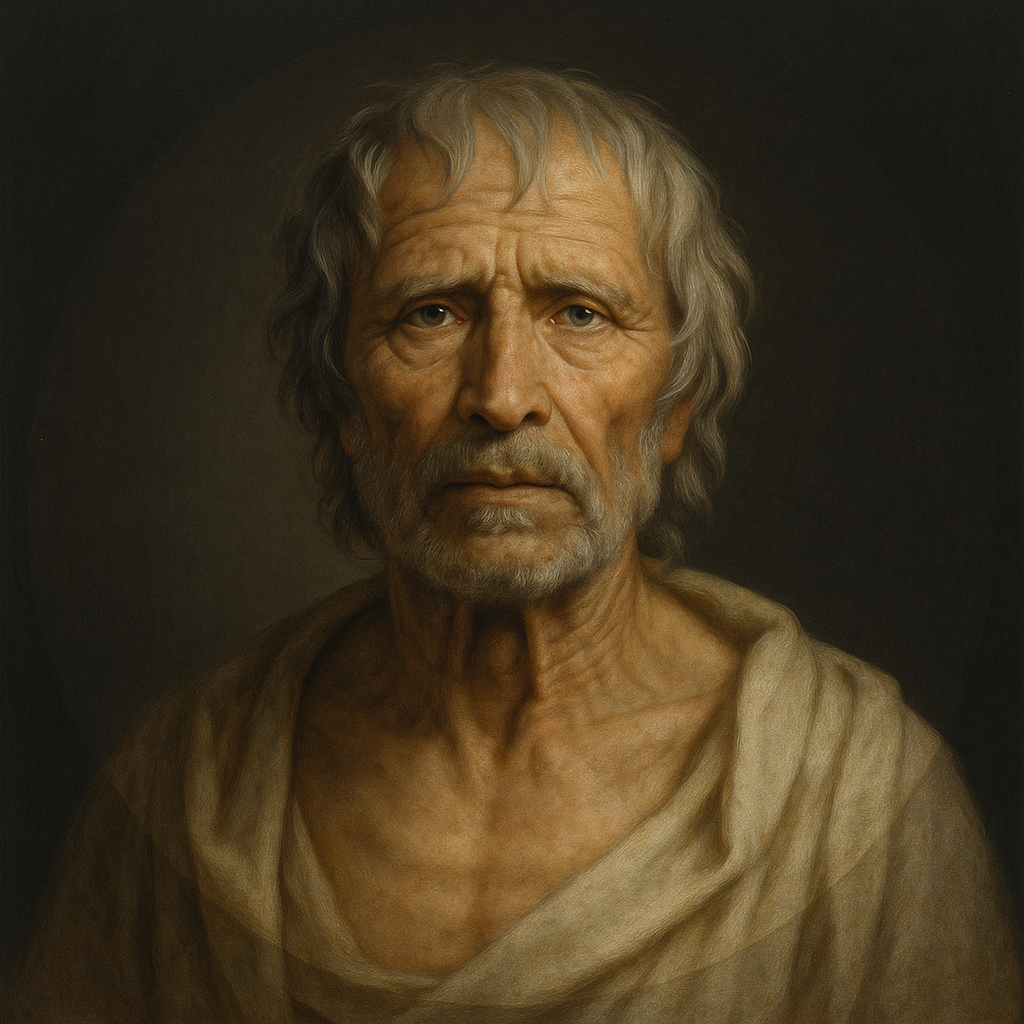
At a glance
- Age
- 84
- Born
- January 4, 1643
- From
- Woolsthorpe, Lincolnshire, England
- Lives in
- England
- Nationality
- Kingdom of England
Biography
The line that gets quoted most often comes back to a single idea: that the apple dropping from a tree and the moon holding its orbit obey the same rule. In the Principia Mathematica, Newton set out that argument with laws and mathematics — inertia, force, action and reaction stated as axioms — and used a single principle of gravitational attraction to account for tides, comets and the shape of the earth. Centuries of scattered observation suddenly had an order to sit inside.
He worked with geometry as his language for nature, and developed methods along the way that anticipated calculus. What made the work hold was the combination: careful, patient measurement on one side, and a willingness to make bold theoretical claims on the other. He drew on those who came before him, but he pressed hard on the question of causes and would not settle for vagueness there.
His optics ran on the same instinct. He split white light into colours with prisms, then recombined them to show what white light was made of, and he built reflecting telescopes to sidestep chromatic aberration — handwork and theory feeding each other. Outside the laboratory he served as Master of the Mint, reforming the coinage and pursuing counterfeiters with a level of detail that suited him, and he led the Royal Society, where he helped set expectations about how a demonstration should be made and how a dispute should be conducted. Rivalries hardened his defences and, by his own habit, tightened his proofs. He also wrote extensively on alchemy and theology, looking for hidden order in those fields too.
Born at Woolsthorpe in Lincolnshire in 1643, he died in 1727. Later physics revised his mechanics for high speeds and strong gravity, but kept it as a precise limiting case, and his calculus grew into analysis and differential equations. Biographers describe someone both reclusive and commanding. What survives most usefully is the working assumption behind everything he did — that the patterns in nature can be described, and then tested.
He worked with geometry as his language for nature, and developed methods along the way that anticipated calculus. What made the work hold was the combination: careful, patient measurement on one side, and a willingness to make bold theoretical claims on the other. He drew on those who came before him, but he pressed hard on the question of causes and would not settle for vagueness there.
His optics ran on the same instinct. He split white light into colours with prisms, then recombined them to show what white light was made of, and he built reflecting telescopes to sidestep chromatic aberration — handwork and theory feeding each other. Outside the laboratory he served as Master of the Mint, reforming the coinage and pursuing counterfeiters with a level of detail that suited him, and he led the Royal Society, where he helped set expectations about how a demonstration should be made and how a dispute should be conducted. Rivalries hardened his defences and, by his own habit, tightened his proofs. He also wrote extensively on alchemy and theology, looking for hidden order in those fields too.
Born at Woolsthorpe in Lincolnshire in 1643, he died in 1727. Later physics revised his mechanics for high speeds and strong gravity, but kept it as a precise limiting case, and his calculus grew into analysis and differential equations. Biographers describe someone both reclusive and commanding. What survives most usefully is the working assumption behind everything he did — that the patterns in nature can be described, and then tested.
Known For
Laws of motion and gravitation; calculus; Opticks; Principia.