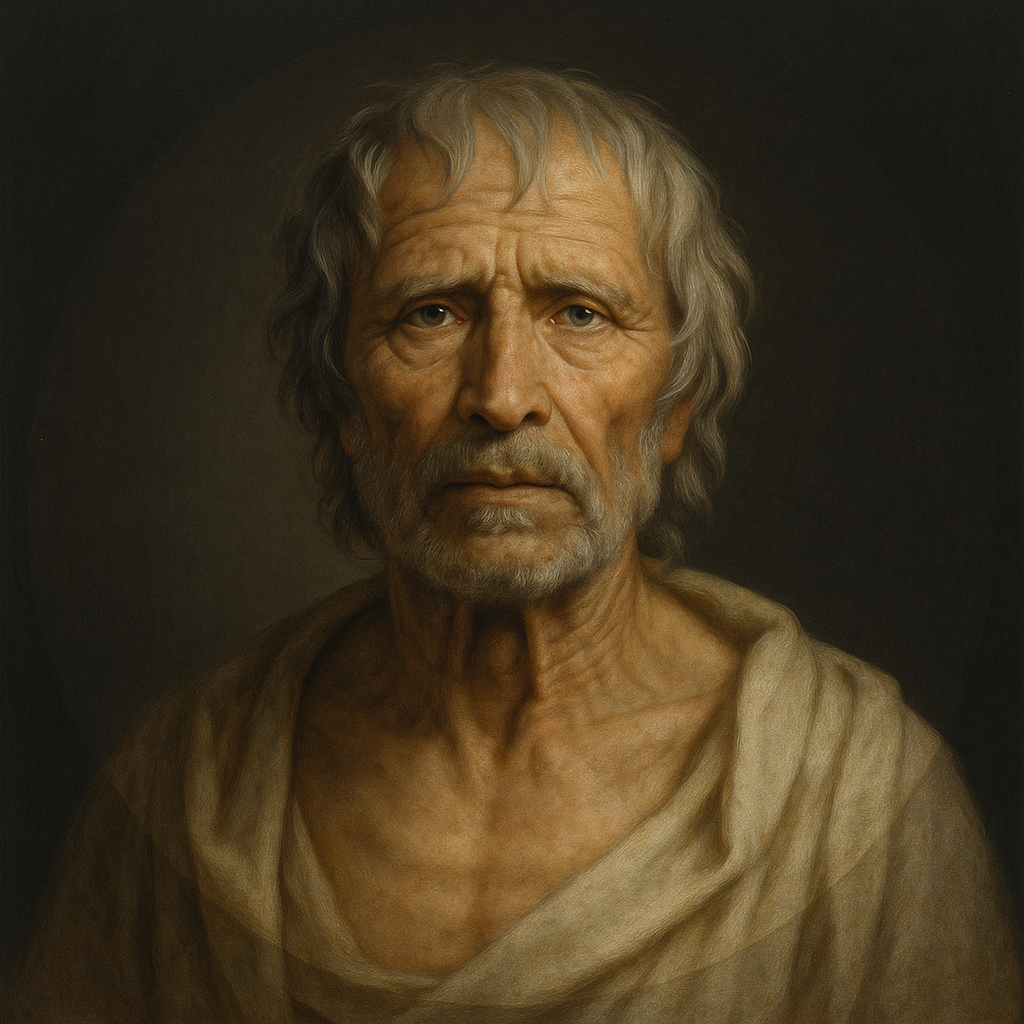
At a glance
- Age
- 67
- Born
- April 15, 1452
- From
- Anchiano, Republic of Florence (Italy)
- Lives in
- Venice
- Nationality
- Republic of Florence
Biography
Most people arrive at him through two paintings — the Mona Lisa and The Last Supper — but the material that keeps circulating among people interested in how work actually gets done is the notebooks. Thousands of fragmentary pages, written in mirror handwriting, moving between exact measurement and something closer to musing: muscles and organs mapped from dissected cadavers, plants, gears, the way water turns in a vortex, the behaviour of clouds. He drew flying machines and self-propelled carts. Most of it stayed on paper, because the materials to build it did not yet exist, but the thinking was clear enough that later engineers found use in it.
He trained as an apprentice in Florence, picking up drawing, sculpture and engineering together rather than in sequence — a combination that shaped everything after. Painting he treated as a problem in light and perception, developing sfumato and atmospheric perspective, and applying mathematical proportion to composition without draining the life out of the figures. The Last Supper builds its drama from perspective, arrangement and the gestures of hands. The Mona Lisa came slowly, glaze over glaze, the depth accumulating rather than being stated.
In Milan he worked for the Sforza court in both capacities at once: artist and engineer, planning fortifications, civic works, festivals and theatrical effects, alongside machines for lifting and bridging. He moved between courts through his career, fitting himself to patrons while continuing his own investigations. The last years were spent in Rome and France, advising on projects and putting his notebooks into some kind of order.
What his admirers tend to take from him is method rather than output — the insistence on looking first, testing rather than assuming, and holding biology, mechanics and design in the same field of view. His drawings circulated after his death and shaped how Europeans learned to draw. Scholars now describe him as an early systems thinker. The plainer description is that he paid attention, at length, to almost everything.
He trained as an apprentice in Florence, picking up drawing, sculpture and engineering together rather than in sequence — a combination that shaped everything after. Painting he treated as a problem in light and perception, developing sfumato and atmospheric perspective, and applying mathematical proportion to composition without draining the life out of the figures. The Last Supper builds its drama from perspective, arrangement and the gestures of hands. The Mona Lisa came slowly, glaze over glaze, the depth accumulating rather than being stated.
In Milan he worked for the Sforza court in both capacities at once: artist and engineer, planning fortifications, civic works, festivals and theatrical effects, alongside machines for lifting and bridging. He moved between courts through his career, fitting himself to patrons while continuing his own investigations. The last years were spent in Rome and France, advising on projects and putting his notebooks into some kind of order.
What his admirers tend to take from him is method rather than output — the insistence on looking first, testing rather than assuming, and holding biology, mechanics and design in the same field of view. His drawings circulated after his death and shaped how Europeans learned to draw. Scholars now describe him as an early systems thinker. The plainer description is that he paid attention, at length, to almost everything.
Known For
Mona Lisa; The Last Supper; notebooks on anatomy, engineering, and flight.
Quotes 5
“Time stays long enough for anyone who will use it.”
“It had long since come to my attention that people of accomplishment rarely sat back and let things happen to them. They went out and happened to things.”
“Learning never exhausts the mind.”
“Art is never finished, only abandoned.”
“Simplicity is the ultimate sophistication.”