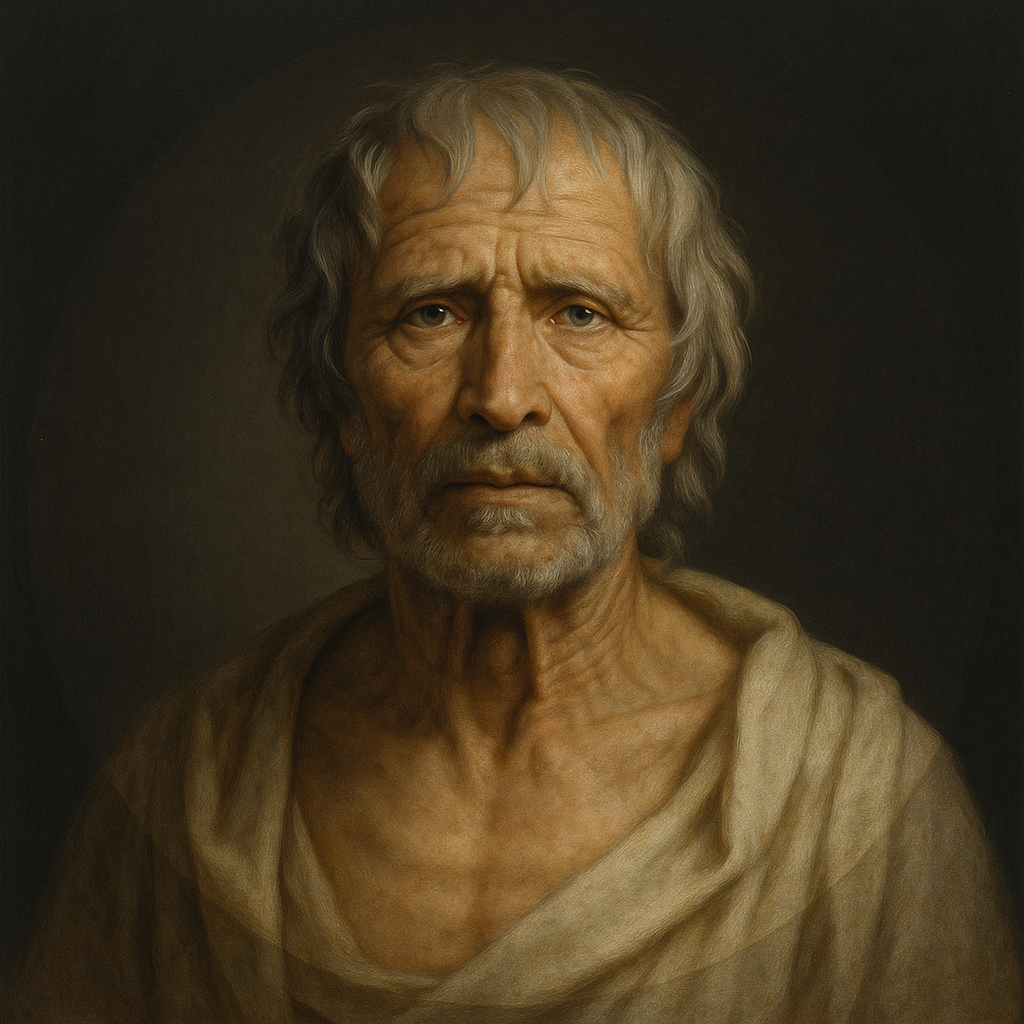
At a glance
- From
- Athens, Ancient Greece
- Nationality
- Classical Athens
Biography
Most people meet him through a line from The Republic or the Symposium — a fragment of argument about justice, or love, or what education is actually for. The setting matters: Plato took the arguing that Socrates did out loud in the Athenian agora and turned it into written dialogue, with characters, scenes and pressure. Read one and you are following a conversation rather than receiving a conclusion. That is why the material still works when it is quoted; it was built to be spoken.
He founded the Academy, one of the first institutions given over to higher learning, and taught people who went on to shape philosophy and science. His idea of education was not technical training. It aimed at moral and civic excellence, and he held that it had to reshape habits rather than simply add information to a person. Philosophy, in his hands, was a public craft answerable to reason.
The subjects ranged widely across his middle and late work: forms, dialectic and mathematics as routes to stable understanding; love in the Symposium; knowledge and recollection in the Meno; language in the Cratylus; the order of the world in the Timaeus; and in the Laws, the compromises that real constitutions require. He also worked carefully on desire, rhetoric and poetry, drawing distinctions rather than verdicts. The literary skill was there to serve clarity — characters carrying the puzzles so a reader could see them.
His work moved through late antiquity into medieval and modern arguments about faith, reason and political order. Neoplatonists reworked his metaphysics; humanists came back to his style and his moral questions; mathematicians and scientists took up his insistence that the world has intelligible structure. Translators kept finding new audiences for the dialogues. The Academy set the pattern for schools as central institutions. What survives most practically is the method: reading Plato means thinking aloud in company.
He founded the Academy, one of the first institutions given over to higher learning, and taught people who went on to shape philosophy and science. His idea of education was not technical training. It aimed at moral and civic excellence, and he held that it had to reshape habits rather than simply add information to a person. Philosophy, in his hands, was a public craft answerable to reason.
The subjects ranged widely across his middle and late work: forms, dialectic and mathematics as routes to stable understanding; love in the Symposium; knowledge and recollection in the Meno; language in the Cratylus; the order of the world in the Timaeus; and in the Laws, the compromises that real constitutions require. He also worked carefully on desire, rhetoric and poetry, drawing distinctions rather than verdicts. The literary skill was there to serve clarity — characters carrying the puzzles so a reader could see them.
His work moved through late antiquity into medieval and modern arguments about faith, reason and political order. Neoplatonists reworked his metaphysics; humanists came back to his style and his moral questions; mathematicians and scientists took up his insistence that the world has intelligible structure. Translators kept finding new audiences for the dialogues. The Academy set the pattern for schools as central institutions. What survives most practically is the method: reading Plato means thinking aloud in company.
Known For
The Academy; dialogues such as The Republic, Symposium, and Phaedo.