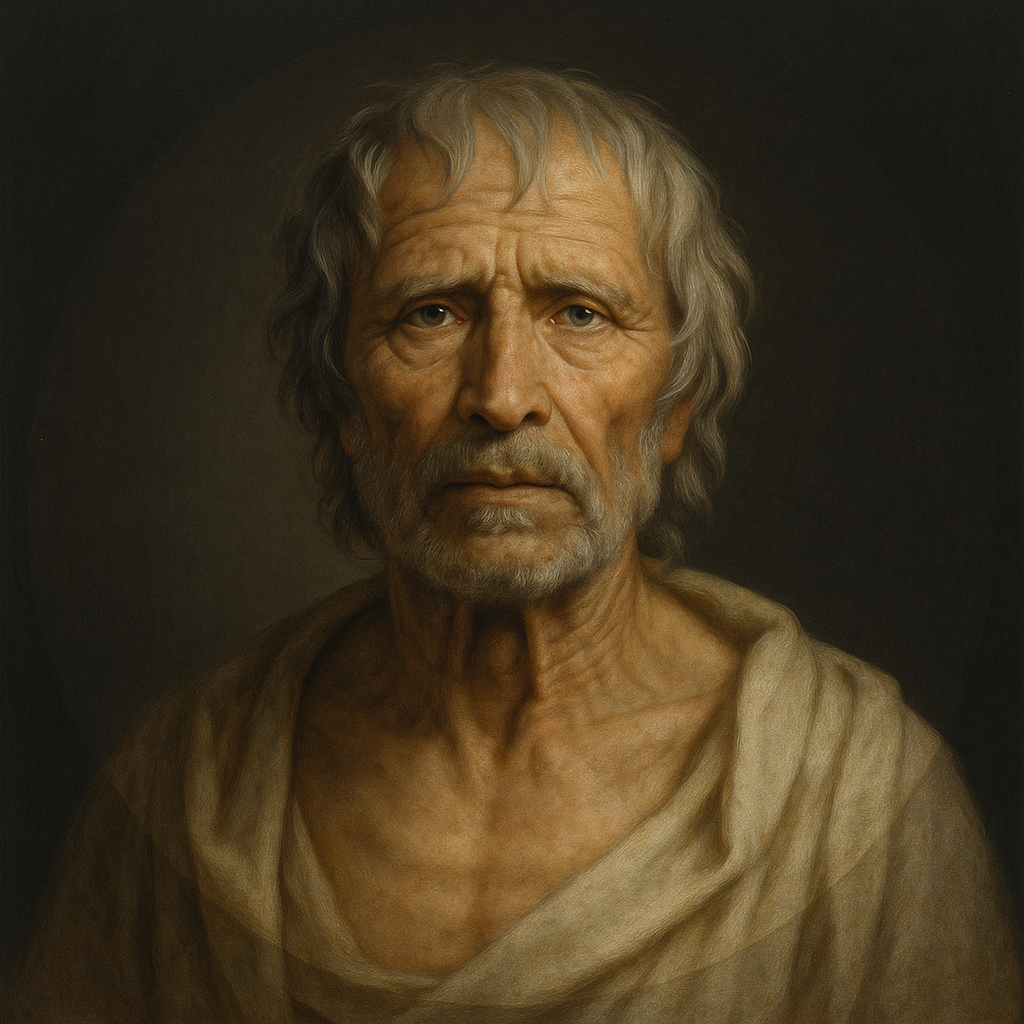
At a glance
- From
- Athens, Ancient Greece
- Lives in
- Classical Athens
- Nationality
- Classical Athens
Biography
The questioning technique that carries his name started as something much less formal than a method: a man in the public spaces of Athens stopping citizens and asking them what justice actually was, or piety, or courage. He would claim to know nothing himself. The questions did the work, pulling out the contradictions in whatever answer he was given and pushing the conversation further than the person had intended to go. Conversation was both his classroom and his trade.
He took no fees, which set him apart from the sophists, and he had no patience for argument aimed at winning rather than at getting things right. Reputation and money ranked below moral clarity in his accounting. His friendships were the kind that put a person's character under pressure. What survives of all this comes through his students, who wrote it down in dialogues that blend record with artistry — the Apology, Crito and Phaedo among them.
The trial is the part most people know. Charged with impiety and with corrupting the young, he stood before an Athenian jury and defended his life of questioning as a service to the city itself. When the verdict came he did not run. His reasoning was that law holds a person even when the law has got it wrong. He drank the hemlock calmly, with friends around him, and that scene has done as much for his standing as any argument he made.
Since then he has been claimed by nearly everyone: sceptics, humanists, religious thinkers, all citing him for intellectual honesty. Themes of virtue and of facing death fed into Stoicism and into early Christian thought. Democracies still return to his trial when they want to measure their own tolerance for dissent, and his case sits awkwardly across any neat line between obedience and defiance. The image that lasted is the barefoot figure in the agora, arguing that knowing yourself is not a private matter but something the whole city benefits from — and that the examined life is never quite finished.
He took no fees, which set him apart from the sophists, and he had no patience for argument aimed at winning rather than at getting things right. Reputation and money ranked below moral clarity in his accounting. His friendships were the kind that put a person's character under pressure. What survives of all this comes through his students, who wrote it down in dialogues that blend record with artistry — the Apology, Crito and Phaedo among them.
The trial is the part most people know. Charged with impiety and with corrupting the young, he stood before an Athenian jury and defended his life of questioning as a service to the city itself. When the verdict came he did not run. His reasoning was that law holds a person even when the law has got it wrong. He drank the hemlock calmly, with friends around him, and that scene has done as much for his standing as any argument he made.
Since then he has been claimed by nearly everyone: sceptics, humanists, religious thinkers, all citing him for intellectual honesty. Themes of virtue and of facing death fed into Stoicism and into early Christian thought. Democracies still return to his trial when they want to measure their own tolerance for dissent, and his case sits awkwardly across any neat line between obedience and defiance. The image that lasted is the barefoot figure in the agora, arguing that knowing yourself is not a private matter but something the whole city benefits from — and that the examined life is never quite finished.
Known For
Socratic method; trial and death; moral inquiry through dialogue.
Quotes 6
“I cannot teach anybody anything; I can only make them think.”
“He who is not contented with what he has, would not be contented with what he would like to have.”
“An unexamined life is not worth living.”
“The only true wisdom is in knowing you know nothing.”
“To find yourself, think for yourself.”
“The unexamined life is not worth living.”